Living on the Costa Brava comes with a cost we rarely add up: between the beach, outdoor work, cycling and the garden, people here accumulate far more hours of sun than in most places. Skin does not forget. The good news is that skin cancer is both the most common cancer and the most curable when it is caught early, and a twenty-minute mole check can settle in one appointment a worry you have carried for months.
Why skin needs watching here
Ultraviolet radiation accumulated over a lifetime is the main risk factor for skin tumours. Three things add up locally: a great many sunny days, a population that lives outdoors, and light reflected off water and sand, which increases your exposure even under a parasol.
It helps to separate two groups of tumours. Non-melanoma skin cancers (basal cell and squamous cell carcinoma) are far more common, grow slowly and tend to appear on the face, ears, scalp and backs of the hands. Melanoma is less frequent but more aggressive; caught while it is still thin, removing it is usually curative.
The ABCDE rule: how to check your own moles
A monthly self-examination in front of a mirror, with someone to help with your back, is the best early-detection tool there is. The ABCDE rule tells you what to look for:
- A for Asymmetry: fold the mole in half and the two halves would not match.
- B for Border: ragged, notched or blurred edges.
- C for Colour: more than one shade within the same lesion (brown, black, red, white or blue-grey).
- D for Diameter: larger than 6 millimetres, roughly a pencil rubber.
- E for Evolving: any change in size, shape, colour or thickness, or new itching, bleeding or crusting.
There is one more useful sign, the ugly duckling: a person's moles usually resemble one another, so the one that clearly stands out from the rest deserves a professional look. Remember the places we tend to forget: scalp, ears, soles of the feet, between the toes and under the nails.
Who is most at risk
Be more careful if you have:
- Fair skin that burns easily and rarely tans, blond or red hair, light eyes and freckles.
- Many moles (more than fifty) or atypical ones.
- A family history of melanoma in a parent, sibling or child.
- Blistering sunburn in childhood or adolescence.
- A previous skin cancer of your own.
- A weakened immune system: an organ transplant or immunosuppressive treatment.
- Outdoor work: farming, fishing, construction, terrace hospitality, sports coaching.
- A history of sunbed use, which raises melanoma risk especially when used before the age of 35.
How often should you be checked?
For an adult with no risk factors, a check every two or three years is usually enough, alongside monthly self-examination. If several of the factors above apply to you, an annual check is the norm; and if you have had a melanoma or atypical moles, your dermatologist will set closer intervals, often every six months. Either way, a lesion that is changing does not wait for the calendar — it should be seen when you notice it.
What happens at the appointment, and what dermoscopy is
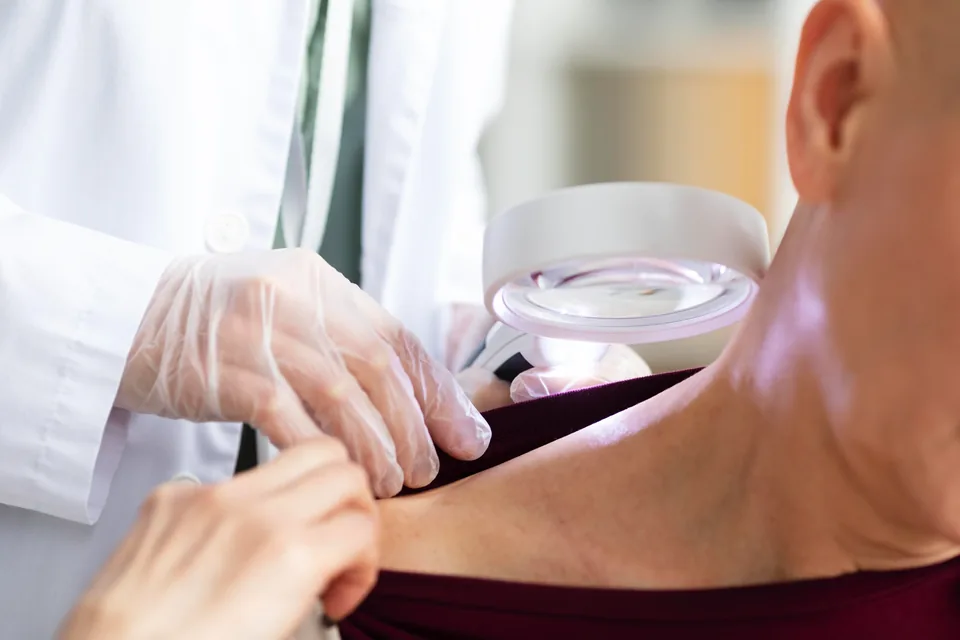
The examination is simple and painless. The dermatologist inspects the whole skin surface under good light, using a dermatoscope: a magnifier with polarised light that reveals structures below the surface of the skin that are invisible to the naked eye. It greatly improves diagnostic accuracy and, just as importantly, avoids removing harmless moles unnecessarily.
If a lesion looks suspicious, removal is arranged under local anaesthetic and the sample goes to the laboratory so that the diagnosis is certain. If it does not, the dermatologist records it and tells you when it should be looked at again. Our dermatology page covers the other conditions we treat: acne, dermatitis, psoriasis, hair loss and warts.
Sun protection, all year round
- SPF 50+ sunscreen on exposed skin, applied thirty minutes before going out and reapplied every two hours and after swimming.
- Stay out of direct sun between midday and 4 pm, when radiation peaks.
- Clothing, a wide-brimmed hat and UV sunglasses protect better than any cream.
- Shade at the beach, remembering that sand and water reflect light back at you.
- Babies under six months should be kept out of direct sun, and for young children protection should be mainly physical. We cover this in our article on child health checks by age.
- No sunbeds, not even to prepare your skin before a holiday.
Frequently asked questions
Is a mole that catches on my clothing dangerous?
Not in itself — friction does not turn a harmless mole into a tumour. That said, if it becomes irritated, bleeds repeatedly or bothers you daily, it is worth having it assessed and, if appropriate, removed.
Can I sunbathe if I have a lot of moles?
Yes, sensibly: high protection, avoid the middle of the day and, above all, never burn. Having many moles is a reason to manage sun exposure well and be checked regularly, not to avoid the outdoors.
Is it covered by my insurance?
We work with more than 40 insurers, and you can check yours on our insurers page. Some policies require prior authorisation for dermatological surgery, and we will tell you when you book.
Booking an appointment
Call 972 30 65 65, use the contact form or our online appointment portal. We are at Plaça de Catalunya, 5 in Palafrugell, open Monday to Friday from 8 am to 8 pm and Saturday from 9 am to 2 pm, and our staff can attend you in English. Come without make-up or nail varnish, and bring any older photographs of the lesion that worries you: comparison is the clearest way to tell whether a mole has changed.