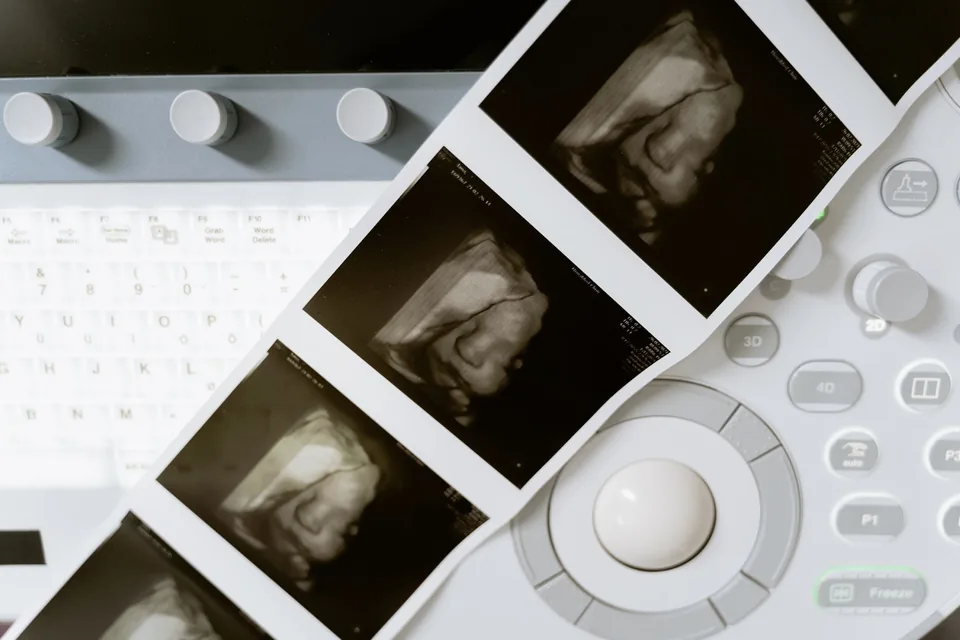
The best time for a 3D pregnancy scan is between roughly 26 and 30 weeks: the baby has enough fat under the skin for the face to look rounded, and there is still fluid in front of it to give a clear image. It is an ultrasound test, safe and painless, that renders the baby's surface in relief and, in 4D, in movement.
What a 3D scan does not do is replace the routine scans of antenatal care: those are 2D, and they are the ones with diagnostic value. The difference is worth understanding, because expectations shape how the appointment feels.
2D, 3D and 4D: what actually differs
All three use the same technology — ultrasound — and the same machine. What changes is how the information is processed:
- A 2D scan produces flat greyscale images. This is the one with diagnostic value: it measures, looks inside organs and assesses growth, amniotic fluid and the placenta.
- A 3D scan reconstructs a volume from many 2D slices and renders its surface. That is where the contours of the face and hands come from.
- A 4D scan is that same volume in motion, in real time: the baby yawning, sucking a thumb or turning over.
Put simply, 2D looks inwards and 3D or 4D looks at the surface. The second never replaces the first.
When is the best time to book?
The window that usually gives the best images is between roughly 26 and 30 weeks. There are two reasons:
- Earlier than that, the baby has very little fat under the skin, so the face looks angular, almost bony.
- Later, space runs out: the baby is lower down, there is less fluid around the face and hands or the cord are often in the way.
With twins it is often worth going a little earlier, as the space fills up sooner.
What will you see, and what may you not?
With a good acoustic window you can see facial features, the profile, ears, hands and feet, and movements such as yawning, swallowing or opening the eyes. It is also a very direct way to share the pregnancy with a partner, grandparents or older siblings.
Image quality, however, depends on things nobody controls:
- The baby's position: if they are facing your spine, there is nothing to be done.
- How much amniotic fluid sits in front of the face, acting as a window.
- The position of the placenta and the characteristics of the abdominal wall.
For that reason we never promise a particular picture. If the baby is not cooperating, a short walk, a change of position or a cold drink often does the trick; if it still does not work, the scan can be repeated another day.
Is a 3D scan safe?
Ultrasound uses sound waves, not ionising radiation. It has nothing in common with an X-ray or a CT scan. It has been used in obstetrics for decades and, performed by a professional in a clinical setting, is considered safe for both mother and baby.
The sensible principle is the one applied to any imaging test: a clear reason for doing it, serviced equipment, the lowest necessary output and no longer than needed. It is also why keepsake scans in non-medical premises, with no clinician accountable for them, are not advisable.
How to prepare
- Drink plenty of water in the days beforehand: amniotic fluid is what makes the image sharp.
- Have a light meal before you come; many babies move more afterwards.
- Wear comfortable two-piece clothing so your abdomen is easy to uncover.
- Allow yourself time. If the baby is poorly positioned, it helps not to be in a rush.
- You are welcome to bring someone with you. If older children are coming, let us know when you book.
What about the routine antenatal scans?
The scans that form part of antenatal care are a different matter, and a 3D scan cannot replace them. There are usually three:
- First trimester, around 11 to 13 weeks: confirms the pregnancy, dates it and measures nuchal translucency.
- The anomaly scan, at around 20 weeks, which reviews the anatomy organ by organ.
- Third trimester, around 32 to 34 weeks: growth, placenta, fluid and the baby's position.
These belong to obstetrics and gynaecology care — the same clinic that later handles the annual gynaecology check-up. Once the baby arrives, paediatric check-ups by age take over.
Frequently asked questions
Do I need to drink a lot of water before a 3D scan?
You do not need a full bladder as in the first trimester, but do keep well hydrated in the days beforehand: amniotic fluid is what makes the image sharp.
Can you tell the baby's sex at a 3D scan?
Usually yes, from the second trimester onwards and provided the baby's position allows it. If you would rather not know, say so before we start and we will not mention it.
Can I bring my partner or older children?
Yes. Let us know when you book so we can prepare the room and allow enough time.
Booking an appointment
We offer 3D and 4D scans and complete antenatal follow-up at the clinic, with English-speaking staff. Call 972 30 65 65 or write to us through the contact form. We are open Monday to Friday from 8 am to 8 pm and Saturdays from 9 am to 2 pm, and we work with more than 40 health insurers.